
Loading...
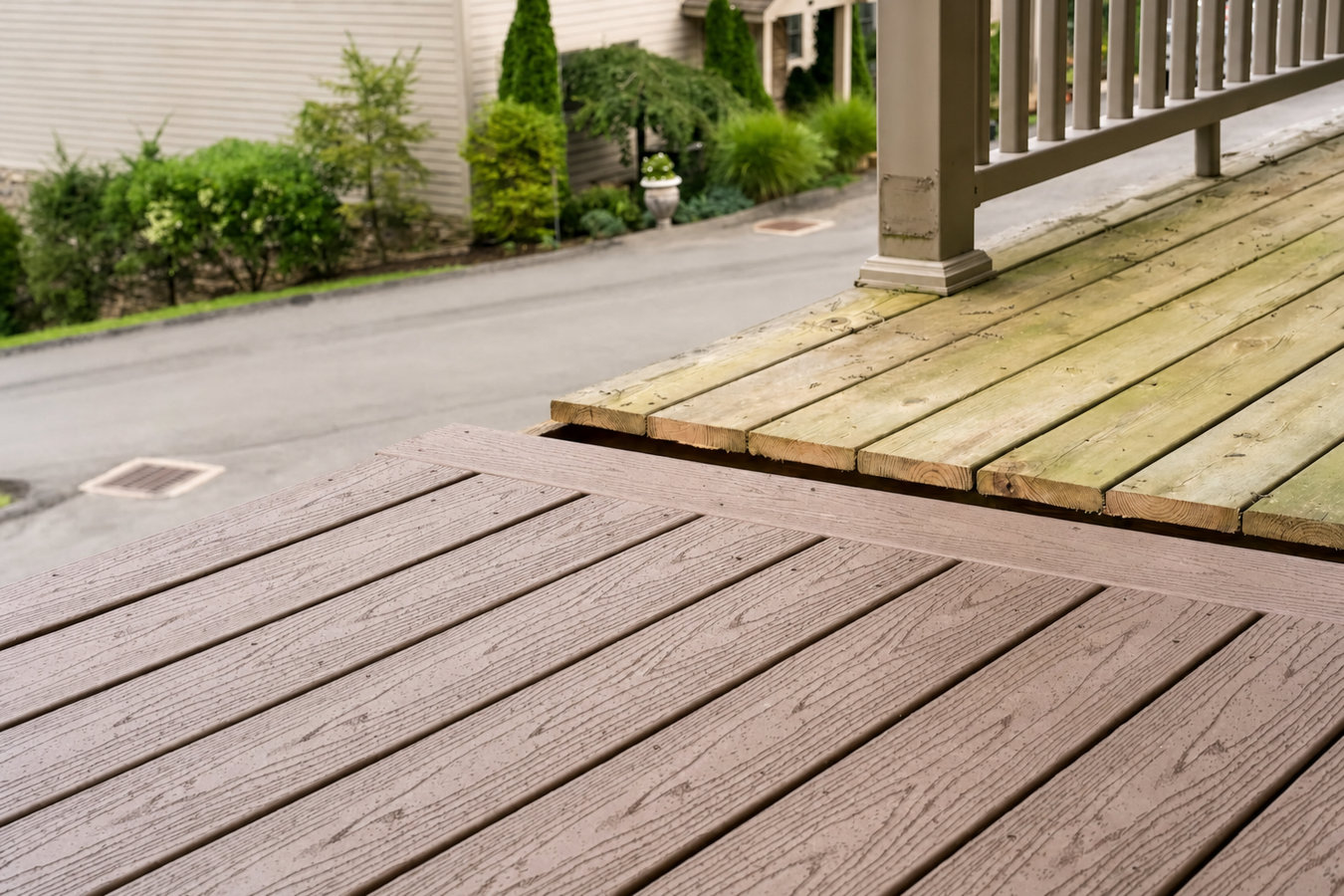
Billerica Deck and Fence builds custom decks, installs Trex composite decking, and puts up fences for Lexington homeowners - with permits pulled from the Lexington Building Department and frost-depth footings set for the full New England winter.
We serve Lexington regularly, and we know the older Colonial and Cape Cod housing stock, the large wooded lots, and the conditions that determine how long an outdoor structure actually holds up here - including the 48-inch frost line that any reputable contractor has to account for on every footing.
Lexington backyards with mature oaks and maples stay damp and shaded well into May, and that extended moisture is exactly what accelerates rot, splitting, and mold on wood decking. Trex composite boards do not absorb water, which means the freeze-thaw damage that works through wood grain every winter has far less effect - and the deck holds its surface and color for decades without annual staining. If you want a low-maintenance deck that handles everything a Lexington winter can throw at it, see our full Trex deck installation service.
Lexington lots are often large and irregular, with grade changes, tree roots, and wooded buffers that all affect where a deck can go and how the framing needs to be laid out. A custom design starts with your actual yard rather than a catalog layout, so the finished deck fits the property instead of working against it. This matters especially on older Lexington Colonials and split-levels where the back of the house rarely lines up with a simple rectangle.
Beyond Trex, the broader range of composite decking options gives Lexington homeowners flexibility on color, grain texture, and price point without giving up the core benefits - no rot, no splinters, no annual sealing. On a Lexington property where the deck may sit under a tree canopy for most of the day, composite is the most practical long-term choice for surface boards.
Cedar is a natural fit for Lexington's older Colonial and Cape Cod neighborhoods because it looks right alongside the wood clapboard siding and traditional trim profiles common on homes built here between the 1940s and 1970s. It holds up to New England moisture better than most wood alternatives, and when finished in a tone that matches the house exterior, a cedar deck looks like it was always part of the design rather than added on years later.
Lexington lots give homeowners real yard space, and a wood privacy fence defines the usable area without looking out of place against the wooded backdrop that characterizes most residential streets here. We set every post in concrete below the frost line so the fence stands plumb after the first hard winter rather than heaving or leaning out of alignment over time.
Lexington has a large share of homes with decks added in the 1980s and 1990s under older building standards - and those decks commonly have shallow footings that have shifted through decades of freeze-thaw cycles, or ledger flashing that was never installed correctly. We assess the structural frame honestly: if the bones are solid, targeted repair makes sense; if the footings have heaved or the ledger is failing, a replacement gives you a structure that will actually last.
Most of Lexington's housing stock dates from the postwar building boom - roughly 1945 through the early 1970s. That means a large portion of homes in town are 50 to 80 years old, and any deck added to those properties in the 1980s or 1990s was built under standards that have since changed. The two most common failures we see on older Lexington decks are shallow footings and missing or deteriorated ledger flashing. The frost line in Middlesex County reaches roughly 48 inches in a hard winter, and a footing that stops at 24 or 30 inches will heave, shift, and eventually crack the framing above it. The surface boards can look fine while the structure underneath has already failed. Homeowners who put off the inspection typically discover the problem when a deck starts pulling away from the house or a railing that used to feel solid starts to wobble.
The local landscape adds its own demands. Many Lexington properties back up to conservation land, and lots with large tree canopies stay damp and shaded well into spring. Clay-heavy glacial soils common throughout this part of Middlesex County drain slowly after snowmelt, which means the ground around footings and fence posts stays saturated into April. Tree roots near walkways and deck footings are one of the most common reasons concrete cracks and heaves on Lexington lots - it is something we plan around on every project rather than discover after the fact. Contractors who have not worked this specific type of property before often underestimate the drainage planning and root clearance required, and homeowners end up with problems that a more careful initial layout would have avoided.
Our crew works throughout Lexington regularly, and we pull permits from the Lexington Building Department on deck, fence, and pergola projects across town. We know what the review process looks like and what the inspector checks at the footing stage, so submissions move through on the first pass rather than bouncing back for corrections.
Lexington covers about 17 square miles, and the housing stock shifts noticeably from one part of town to another. The streets near the historic Battle Green and the town center include some of the oldest homes in Lexington - Colonials with original wood clapboard siding, stone foundations, and mature trees whose roots run right through the areas where footings and fence posts need to go. Out toward the quieter residential streets on the edges of town, properties are more suburban in character, with larger lots and newer construction that came up in the 1960s and 1970s. Whether your home sits close to the Minuteman Bikeway or on a quieter cul-de-sac, we have worked on homes throughout Lexington and understand what those properties need.
We also serve the towns neighboring Lexington. To the northwest, Bedford, MA shares many of the same mid-century housing conditions and wooded lot characteristics that we see in Lexington. To the south, Woburn, MA is another area we serve regularly with the same commitment to proper footings, permitted work, and honest assessments.
Reach us by phone or through the contact form and describe what you are looking to build. We respond within 1 business day to schedule an on-site visit, and you do not need to have detailed plans ready - that comes after we see the property.
We visit the property, look at the site conditions - grade, tree proximity, existing structures, soil - and walk through material and design options with you. The estimate is free, and this is where we discuss budget, timeline, and what the permit process looks like for your specific project in Lexington.
Once you approve the plan, we handle the permit application with the Lexington Building Department. Permit review typically takes two to four weeks. We schedule your build start around the approval date, so there is no gap in momentum once the permit clears.
Construction begins with footings and framing - the inspector checks the frame before surface boards go on. After final inspection and sign-off, we walk through the finished project with you, clean up the site, and you have a structure built to code with a permit on record.
We serve Lexington, MA homeowners with free on-site estimates, permitted builds, and honest assessments. Call us or submit your project details and we will respond within 1 business day.
(978) 294-0937Lexington is a mature suburb about 11 miles northwest of Boston, covering roughly 17 square miles with a population of around 34,000. The town is best known nationally for the Battle Green, where the first shots of the American Revolution were fired in April 1775. That historic center anchors a compact, walkable downtown, while the surrounding neighborhoods spread out into quiet, tree-lined residential streets. Most of the town is single-family homes on lots ranging from a quarter acre to over an acre, heavily owner-occupied by long-term residents who invest significantly in maintaining their properties.
The housing stock is dominated by mid-20th century construction - Colonials, Cape Cods, and split-levels built during the postwar suburban expansion from the late 1940s through the early 1970s. Median home values in Lexington are among the highest in Massachusetts, and homeowners here tend to approach improvements as long-term investments rather than quick fixes. Near the historic town center, a smaller number of pre-1900 homes with fieldstone foundations and original wood framing require more careful handling than the postwar stock. Adjacent to Lexington, communities like Burlington, MA to the west and Woburn, MA to the south share many of the same housing and soil conditions - and we serve all of them.
Get a deck designed and built to match your home and lifestyle perfectly.
Learn MoreLow-maintenance composite decking that looks great year after year.
Learn MoreAffordable pressure-treated wood decks built to handle New England weather.
Learn MoreNaturally beautiful cedar decks with excellent rot resistance.
Learn MoreProtect and refresh your deck with professional staining and sealing.
Learn MoreSlip-resistant, custom pool decks built for safety and summer enjoyment.
Learn MoreDurable vinyl fencing that adds privacy and curb appeal with no upkeep.
Learn MoreClassic wood and privacy fences installed to secure your property.
Learn MoreEnjoy the outdoors bug-free with a professionally screened porch or deck.
Learn MoreStay comfortable outside in any weather with a covered deck or patio.
Learn MoreCook and entertain outdoors with a purpose-built outdoor kitchen deck.
Learn MoreSafe, stylish deck railings installed to match your deck perfectly.
Learn MoreWe serve Lexington homeowners with custom decks, Trex composite installations, fences, and pergolas - all permitted, all built to last through New England winters.